
Cassava Starch vs. Cassava Flour: What’s the Difference?
Cassava starch and cassava flour both come from the same root, but they are not the same product.
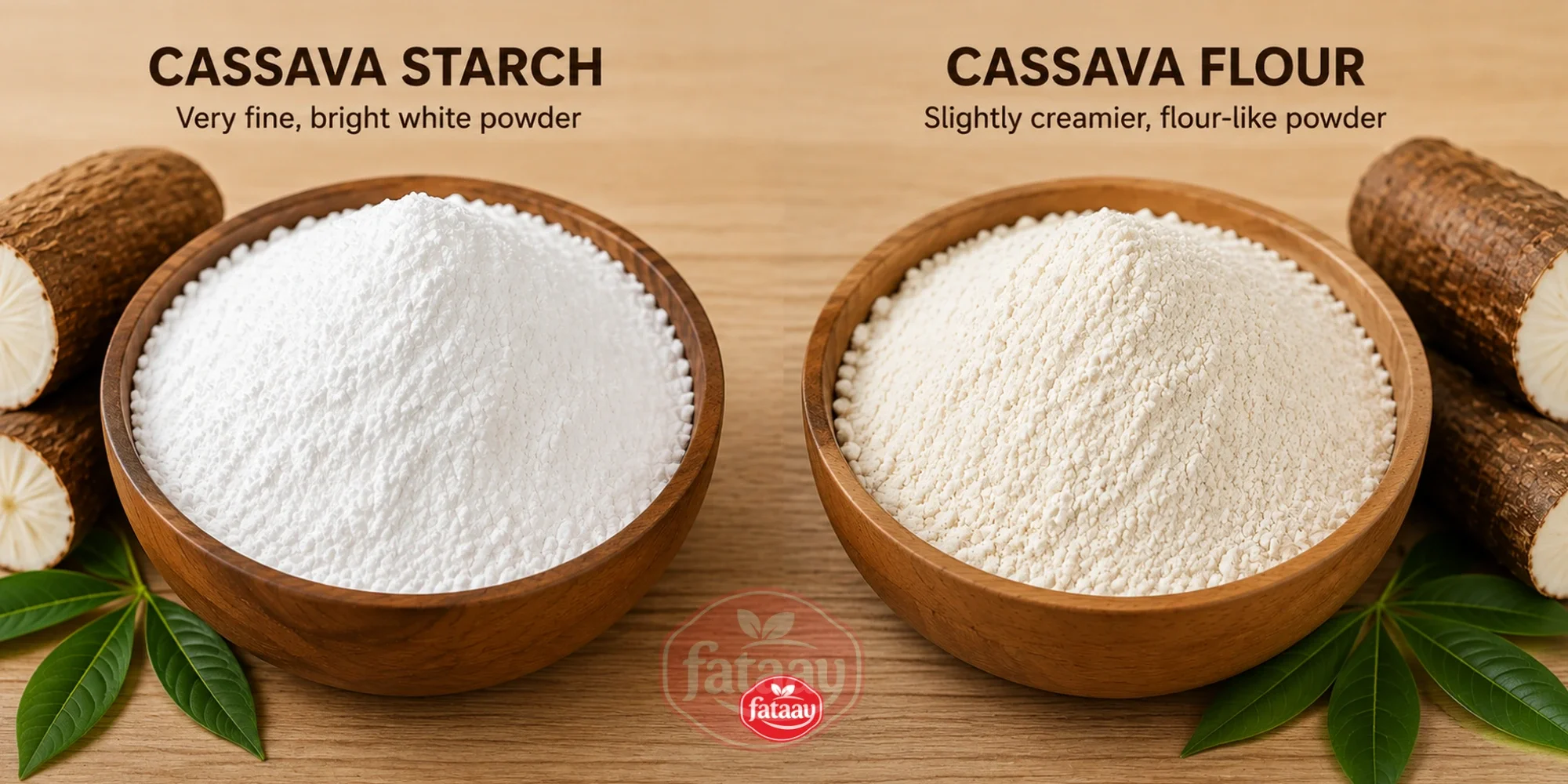
The main difference is how they are processed and what they are used for. Cassava flour is made by drying and grinding the cassava root, while cassava starch is extracted from the root and purified to produce a fine starch powder.
This difference is important for food manufacturers, industrial buyers, and anyone looking to use cassava as an ingredient.
In this guide, we explain the difference between cassava starch and cassava flour, how each product is made, their common uses, and how to choose the right one for your application.
Cassava Starch vs. Cassava Flour
What Is Cassava Flour?
Cassava flour is made from the whole peeled cassava root.
The roots are cleaned, peeled, washed, cut or grated, dried, and then milled into flour. Because the product comes from the whole root, cassava flour contains more of the root's natural components than purified cassava starch.
High-quality cassava flour can be used as a food ingredient in products such as baked foods, snacks, and other foods where a flour-like ingredient is needed.
How Is Cassava Flour Made?
Cassava flour is made from the peeled cassava root through these main steps:
Harvesting Fresh Cassava
Cleaning and Washing
Peeling
Grating (Rasping)
Dewatering
Drying
Milling and Sieving
For a detailed explanation of each step, read our Cassava Flour Processing: Step-by-Step Guide to Producing High-Quality Cassava Flour.
What Is Cassava Starch?
Cassava starch is the starch extracted from cassava roots.
Unlike cassava flour, the goal is not simply to dry and grind the whole root. The cassava is processed to release the starch granules, which are then separated from the other parts of the root and purified.
The starch is then dewatered, dried, and finished into a fine powder.
This gives cassava starch properties that make it useful in many food and industrial applications.
How Is Cassava Starch Made?
Cassava starch is made by extracting and purifying the starch from fresh cassava roots.
The main steps are:
Harvesting
Cleaning
Washing
Peeling
Crushing/Rasping
Separation/Sieving
Concentration and Purification
Dewatering
Drying
Packaging
For a detailed explanation of the cassava starch production process, read our How Cassava Starch Is Produced.
Cassava Starch vs. Cassava Flour: Key Differences
Although both products start with cassava roots, they have different characteristics and applications.
| Feature | Cassava Flour | Cassava Starch |
|---|---|---|
| What it is | Flour made from dried cassava root | Starch extracted from cassava |
| Processing | Drying and milling the root | Extraction, separation, purification, and drying |
| Composition | Contains starch along with other components of the root | Primarily purified starch |
| Appearance | Fine, flour-like powder | Fine, usually white starch powder |
| Main role | Flour or food ingredient | Functional ingredient and industrial raw material |
| Common uses | Baking and food products | Food, paper, textiles, adhesives, and other industries |
| Processing focus | Producing a usable flour | Recovering and purifying starch |
The two products can therefore look similar, but they are designed for different purposes.
What Is Cassava Flour Used For?
Cassava flour is mainly used as a food ingredient.
Depending on its quality and processing method, it can be used in:
Bread and baked products
Biscuits and snacks
Flatbreads
Other flour-based foods
Gluten-free food products
High-quality cassava flour has also been studied as a substitute for part or all of wheat flour in some food products.
However, cassava flour should not automatically be treated as a direct replacement for wheat flour in every recipe. The properties of each flour are different, so the right formulation depends on the final product.
What Is Cassava Starch Used For?
Cassava starch has a much wider range of applications.
Food Manufacturing
Cassava starch can be used as a:
Thickener
Binder
Stabilizer
Filler
Ingredient in baked and processed foods
Starch is widely used in food manufacturing because of its functional properties.
Paper and Packaging
Cassava starch can also be used in paper and packaging applications, including processes where starch is needed for coating, sizing, or binding.
Textile Industry
Starch can be used in textile processing, including as a sizing material.
Adhesives
Cassava starch can be processed for use in adhesives and other binding applications.
Other Industrial Applications
Cassava starch can also serve as a raw material for further processing into other starch-based products.
This makes cassava starch more than just a food ingredient. It can be an important industrial raw material across several sectors.
Is Cassava Starch the Same as Tapioca Starch?
In many food and commercial contexts, cassava starch is also called tapioca starch.
However, product names can vary between markets and suppliers. When buying cassava starch for manufacturing, it is important to look beyond the name and check the product specification.
Factors such as moisture, purity, viscosity, color, particle size, and other quality requirements can matter depending on how the starch will be used.
Can Cassava Flour Be Used Instead of Cassava Starch?
Not always.
Even though both products come from cassava, their properties are different.
Cassava flour contains more of the components of the cassava root, while cassava starch has gone through an extraction and purification process.
For example, a food manufacturer looking for a starch to provide thickening or other specific functional properties may need cassava starch rather than cassava flour.
Similarly, a manufacturer looking for a flour-like ingredient may need cassava flour instead.
The right choice depends on the product being made and the function the cassava ingredient needs to perform.
Which One Should You Choose?
The best option depends on your application.
Choose cassava flour when:
You need a flour-like food ingredient.
You are developing baked or flour-based foods.
You want to use cassava in a food formulation where the whole-root flour is appropriate.
Choose cassava starch when:
You need a purified starch ingredient.
You need thickening or binding properties.
You are producing processed foods.
You need starch for paper, textiles, adhesives, or other industrial applications.
Your production process requires a specific starch specification.
For businesses, the most important question is not simply “Which product is better?”
The better question is: “Which product is right for my application?”
Why the Difference Matters for Businesses
For manufacturers and industrial buyers, understanding the difference between cassava starch and cassava flour is important when sourcing raw materials.
Using the wrong product can affect the performance, quality, and cost of the final product.
A buyer should consider:
Application: What will the product be used for?
Quality: What technical specifications are required?
Consistency: Can the supplier provide consistent quality from batch to batch?
Supply: Can the supplier provide the required volume?
Packaging: Does the packaging meet your handling and storage needs?
Logistics: Can the product be delivered reliably?
Specifications: Does the product meet the requirements of your manufacturing process?
For industrial applications, quality is closely linked to the intended end use. Different industries may require different tests and specifications before accepting a starch product.
Why Cassava Starch Is Important for Industry
Cassava is a versatile crop that can be turned into different value-added products.
Cassava starch is particularly useful because it can serve as a raw material across both food and non-food industries.
Food manufacturers may use it for its functional properties, while industries such as paper, textiles, and adhesives can use starch as a binding or processing material.
This creates an opportunity to move cassava beyond traditional food uses and into higher-value industrial applications.
For countries with large cassava production, developing reliable processing capacity can help connect farmers to larger industrial markets.
Cassava Starch vs. Cassava Flour: The Simple Answer
The difference can be explained in one sentence:
Cassava flour is made by drying and milling cassava roots, while cassava starch is extracted, separated, and purified from the cassava root.
Both products have value, but they serve different purposes.
Cassava flour is mainly used as a flour-like food ingredient, while cassava starch can be used in food manufacturing and a range of industrial applications.
Understanding this difference helps manufacturers and buyers choose the right cassava product for their needs.
Looking for Cassava Starch for Industrial Use?
At Fataay, we are developing cassava processing capacity in Nigeria to produce high-quality cassava starch for industrial and food applications.
Our goal is to connect Nigeria's cassava supply with manufacturers that need reliable, quality-controlled starch.
If your business is interested in sourcing cassava starch or discussing potential supply opportunities, contact Fataay to learn more about our products and capabilities.
Final Takeaway
Cassava flour and cassava starch come from the same crop, but they are not the same product.
Cassava flour is made from the dried cassava root and is mainly used as a food ingredient.
Cassava starch goes through an additional extraction and purification process. This produces a starch with properties that make it useful in food manufacturing and several industrial applications.
For businesses, choosing between the two should always start with the intended application, required specifications, and quality requirements.