
How Cassava Starch Is Produced
Cassava starch is extracted from fresh cassava roots and processed into a fine white powder used in food and manufacturing industries.
The production process involves several stages to ensure the starch is clean, dry, and suitable for commercial use. In modern factories, machines are used to process cassava efficiently, improve consistency, and support large-scale production with minimal waste.
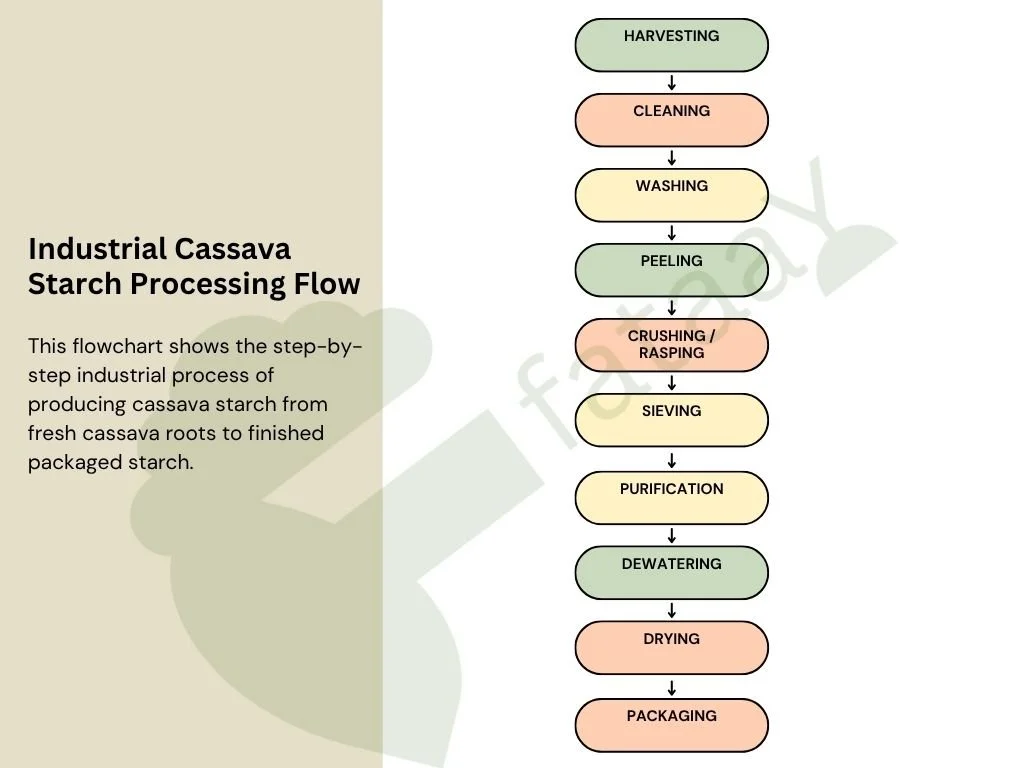
1. Harvesting
Mature cassava roots are harvested from farms and transported quickly to the factory using transport trucks to prevent spoilage and maintain quality.
2. Cleaning
The cassava roots are cleaned using a vibrating cleaning screen or dry sieve to remove soil, stones, leaves, and other impurities.
3. Washing
The cleaned roots are thoroughly washed with clean water in a paddle washer or drum washer to remove sand and remaining dirt.
4. Peeling
The outer skin of the cassava roots is removed using a mechanical cassava peeler to improve starch purity and reduce contamination.
5. Crushing/Rasping
The peeled cassava roots are crushed into a pulp using a cassava rasper or crusher to release starch from the cells.
6. Separation/Sieving
The cassava slurry is passed through a centrifuge sieve or rotary sieve to separate starch milk from fibrous materials.
7. Concentration & Purification
The starch milk is refined using a hydrocyclone system to remove fine impurities such as proteins, fibers, and cell sap.
8. Dewatering
The purified starch is processed in a centrifuge dewatering machine to remove excess water and form a thick starch cake.
9. Drying
The starch cake is dried into a fine powder using a flash dryer with hot air circulation to reduce moisture content.
10. Packaging
The dried cassava starch is packed using an automatic packaging and sealing machine to protect it from moisture and contamination.
Importance of Cassava Starch
Cassava starch is widely used across many industries due to its versatility, affordability, and functional properties. It is commonly used in food processing, paper production, textiles, adhesives, pharmaceuticals, and biodegradable products.
According to the Food and Agriculture Organization, cassava can be processed into starch, flour, chips, alcohol, and other industrial products with significant commercial value. FAO